
Demystifying Commercial Litigation: Frequently Asked Questions
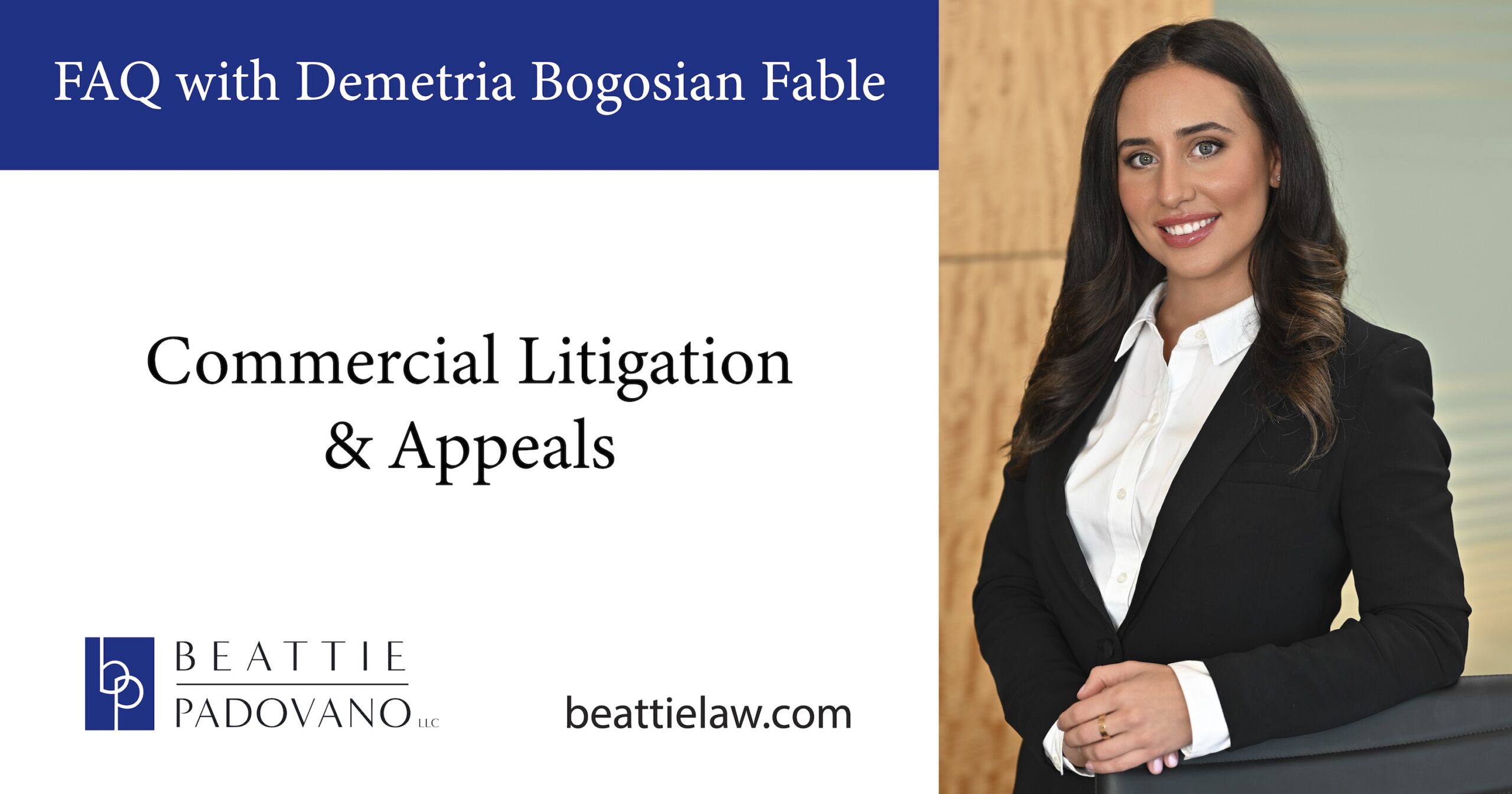
Demystifying Commercial Litigation: Demetria M. Bogosian Fable, Associate Attorney at Beattie Padovano, LLC, Answers Frequently Asked Questions on the Topic
What types of cases generally fall into the commercial litigation category?
At Beattie Padovano, we handle almost any commercial litigation matter.
Generally, we represent clients in complex commercial disputes, often involving breach of contract and fraud claims, as well as disputes concerning business dissolutions.
Our firm has also worked with clients on complex land disputes, which oftentimes encompass affordable housing elements. In addition, we have worked on intellectual property disputes. The wonderful part about being a member of the litigation team at Beattie Padovano is that we have a group who are experienced across many different areas, and together we can often determine what course of action will yield the best outcomes for our clients.
What kind of investment of time should our company expect when it comes to the discovery and evidence-gathering phase?
Litigation certainly involves a commitment of time, particularly during the discovery phase. At Beattie Padovano, we are committed to streamlining that process as much as possible by making our requests simple and understandable for clients.
Generally, the discovery process permits for broad exploration and sometimes includes matters that may not necessarily seem relevant and which may feel burdensome at first. However, our team thoroughly reviews every request with our clients to provide context and explanations. We aim to expedite the discovery phase by detailing for our clients exactly what they should be searching for. We also offer platforms that make it extremely easy for our clients to bulk-upload necessary documentation and evidence in native formats.
Once that initial phase is concluded, we work together with our clients to ensure that everyone is fully prepared for depositions.
Under what circumstances might you recommend pursuing a trial rather than mediation or arbitration?
The truth is, the best case is a settled case; however, not every case is “settle-able”.
The distinction between a good lawyer and a great lawyer is the ability to know the difference.
Settlement, through any alternative means, i.e., mediation, arbitration, complementary dispute resolution, etc., allows the parties to maintain control over the terms. Trials, however, maintain an element of the unknown and often come with unexpected surprises. It is difficult to predict which way a jury may lean. However, if my client and I are able to try certain aspects of a case, such as damages only, after successfully proving liability on summary judgment, then trial might be the best decision. Likewise, conducting a trial before a judge, with no jury, is sometimes a better decision than settling.
Determining the best path is dependent on the specific facts and circumstances surrounding a situation; it requires skilled and experienced legal counsel who can guide the client in the right direction.
What do we need to know about appealing a decision? Is there a limited window of opportunity during which our company can do so, and what are some examples of legal errors that can form the basis for a successful outcome?
There are many types of appeals that can be raised during a matter.
There are interlocutory appeals and final appeals; knowing the difference is crucial. Many attorneys conflate the two and receive a quick denial on the grounds that the matter has not been concluded as to all issues and all parties.
Filing for a motion to reconsider is going to be the logical first step before deciding whether to appeal. Similar to appeals, knowing when (or when not) to file a motion to reconsider is invaluable to a case.
Deciding whether to appeal a court order requires an in-depth analysis. How important is the issue being appealed? Is it final or interlocutory (and if interlocutory, will it have a major impact on the resolution of the case)? Is this case settleable? How much will this cost? Are we still within our time to appeal or can we apply for an extension of time? What is the likelihood that a stay will be granted during the appeal? Is this an emergent application?
There are certain time frames required for each appeal that must be closely monitored. It is also important to remember that appeals can be very costly. Before sharing our opinion on whether to file an appeal, we always engage clients in a meaningful conversation regarding the pros and cons.
What steps do you recommend we take to protect the reputation of our company as we pursue litigation?
When pursuing litigation, we highly recommend that clients refrain from discussing the matter publicly, especially on social media, and to negotiate a Discovery Confidentiality and Protective Order at the start of the process.
Litigation often involves disclosure of very private information, including but not limited to financial and private business matters. By agreeing to a Discovery Confidentiality and Protective Order, the client is able to keep certain documents and data out of the public record and to establish control over who gets to view what documents, which manner and/or forum the documents can be utilized, and what happens to them after the litigation concludes.
What else do we need to know about the role of our attorney in this process?
The right legal counsel can make all the difference in your case. Engaging an experienced attorney who has a comprehensive understanding of the law, and sometimes, more importantly, knows the “players” involved can help garner the best results. Having experience with the different Judges, understanding what they like or dislike and how they respond to certain scenarios can be incredibly helpful.
It is important to find a lawyer who has strong listening and communication skills, thoroughly understands your case, works well with others (especially opposing counsel), and remains steadfastly committed to representing your interests. The best case is a settled case, and this kind of resolution is possible when the attorneys can have open and respectful dialogue with one another.
Here at Beattie Padovano, you can expect zealous advocacy as we work toward getting optimal results.
Demetria (Demi) Bogosian Fable is an associate in the Firm’s Commercial Litigation & Appeals department. Her practice includes all areas of civil litigation with a focus on complex commercial litigation and estate litigation.
A graduate of Seton Hall University School of Law (2020), Demi earned her Bachelor of Science in Business Administration from Monmouth University in 2016, where she was a member of Delta Phi Epsilon and the Phi Eta Sigma Honor Society. Prior to joining Beattie Padovano, Demi clerked for the Honorable Michael N. Beukas, J.S.C., Superior Court, Bergen County and worked at another Bergen County law firm.
Demi is a member of the Justice Morris Pashman American Inn of Court; American Bar Association; New Jersey State Bar Association; Bergen County Bar Association; Young Lawyers’ Division. She is also a member of the River Vale Joint Planning Board and the Mahwah Regional Chamber of Commerce.
Learn more about Demetria M. Bogosian Fable, Associate Attorney at Beattie Padovano, LLC, by visiting Demetria M. Bogosian Fable – Beattie Padovano, LLC
No aspect of this advertisement has been approved by the New Jersey Supreme Court. This publication is for informational purposes. It does not constitute legal advice or create an attorney-client relationship. The content is current as of date and time of its publication. It may not reflect developments or changes in the law that have occurred since its publication. Beattie Padovano, LLC, and the attorneys that authored this content disclaim any and all liability with respect to actions taken or not taken based on any or all of the contents of this publication. For further information, please contact the attorneys who authored this publication.